Recording the Caregiver: Where Household Cameras End and Wiretapping Begins
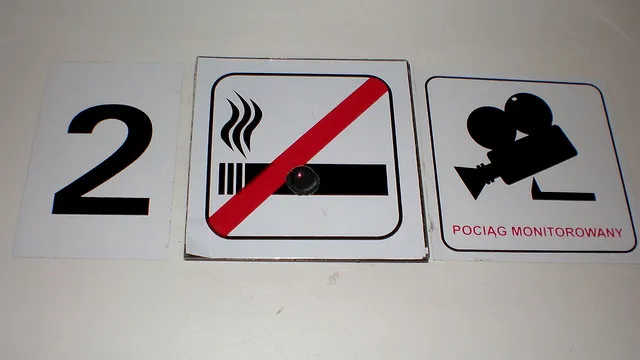
Photo: Paweł Zdziarski from Rumia, Poland, CC BY-SA 2.0, via Wikimedia Commons
The small camera tucked into a bookshelf has become as standard in American households as the smoke detector. Sales of indoor surveillance devices climbed steadily through the last decade, and the pandemic accelerated the habit: once families began spending entire days at home with nannies, cleaners, and contractors moving through the house, many wanted a record of what happened when they stepped out.
Most owners think of these devices as a security purchase. Fewer consider that the same device can, depending on the state and the circumstances, place them on the wrong side of federal wiretapping law.
The Two-Track Rule: Video and Audio
The legal treatment of home surveillance splits cleanly down the middle. Video recording in the common areas of your own home — a living room, a kitchen, a nursery — is broadly lawful across the United States. No state requires a homeowner to post notice that a living room contains a camera.
Audio is a different matter. The federal Wiretap Act and its state analogues treat the interception of spoken conversations with far more suspicion than the capture of images. Under the federal baseline, recording a conversation is legal only if at least one party consents. A homeowner who is not present when the babysitter takes a phone call is not a party to that call.
Most states follow this one-party rule, which means a hidden microphone may still be lawful if the homeowner consents — but a dozen or so states, including California, Florida, Illinois, Maryland, Massachusetts, Pennsylvania, and Washington, impose a stricter all-party consent standard. In those jurisdictions, recording a caregiver's conversation without her knowledge isn't a privacy gray area. It is, in the plain language of the statutes, illegal interception.
Many consumer cameras make this trap easy to fall into. Two-way talk features, built-in microphones, and ambient audio capture are switched on by default. A device purchased to watch an infant may be recording every conversation in the room.
What the Lawyers Say
Employment attorneys describe a familiar pattern. A homeowner discovers a caregiver doing something troubling — scrolling on her phone for hours, handling a child roughly, helping herself to the liquor cabinet — and the footage becomes the centerpiece of a dispute. Then the audio surfaces.
"The video almost never causes a problem," one New Jersey employment lawyer told us, describing cases she has reviewed. "The audio is what turns a nuisance into a lawsuit. Homeowners assume that because they own the house, they own the recording. The law doesn't work that way."
The consequences are not hypothetical. Civil damages under wiretap statutes can run to statutory amounts per violation, and plaintiffs' attorneys have pursued homeowners over covert audio with growing regularity. In the worst cases, recordings made without consent have been excluded from evidence entirely — meaning the homeowner captured wrongdoing and then destroyed the legal value of the proof by capturing it unlawfully.
The Rooms That Change Everything
Location matters as much as sound. A camera in a living room is one thing. The same camera in a bathroom, a guest bedroom where a housekeeper changes clothes, or any space where a worker has a reasonable expectation of privacy, moves the analysis from wiretapping into a different and uglier category: unlawful surveillance and, in many states, criminal voyeurism.
Privacy advocates emphasize that household workers — unlike family members — have limited ability to negotiate the terms of their surveillance. A housekeeper who encounters a hidden camera in a bathroom has few practical options in the moment. The power imbalance is why advocacy groups have pushed for clearer notice requirements and, in some state legislatures, for rules that would require disclosure of cameras in homes where domestic workers are employed.
Employment law adds a further wrinkle. Caregivers and household staff may be employees, and workplace surveillance of employees carries its own constraints under state law. A homeowner who records a worker's breaks, personal calls, or private moments may run afoul of rules that go beyond wiretapping statutes altogether.
A Practical Framework for Households
Attorneys and privacy researchers tend to converge on a short list of principles for families that want monitoring without legal exposure:
- Disable audio by default. If the device cannot have its microphone permanently turned off, choose one that can.
- Limit cameras to shared, functional spaces. Nurseries, kitchens, and entryways are defensible. Bathrooms and bedrooms of adult workers are not.
- Disclose. A simple statement — "we have cameras in the living areas" — costs nothing, prevents most disputes, and converts covert monitoring into transparent monitoring. Some families put it in writing with a household employment agreement.
- Check the state. The twelve-plus all-party consent states are where audio recording becomes genuinely dangerous. Residents there should treat any microphone capture of a third party as off-limits.
- Never record where privacy is expected. This is the bright line. Crossing it converts a safety tool into evidence of a crime.
The Ethics Behind the Statutes
It is worth stating plainly that legality and legitimacy are not the same thing. A camera that complies with every statute can still reshape a relationship. Caregivers who know they are watched — or who discover they were watched without notice — describe the experience as corrosive, even when the footage was benign. Childcare workers in particular report that undisclosed cameras make them hesitant to raise concerns about the child or the household, since the recording could always be used against them.
The most defensible position, and the one increasingly recommended by both employment lawyers and privacy advocates, is disclosure paired with restraint: visible cameras in shared spaces, microphones off, and a clear understanding with the people who keep a home running. Surveillance, like any security measure, works best when the people it touches are treated as parties to it rather than subjects of it.
The technology in a nanny cam is trivial. The judgment about how to use it is not — and in a dozen states, that judgment carries the weight of criminal law.