One Port, Many Risks: What Really Happens When You Plug Into a Public USB Charger
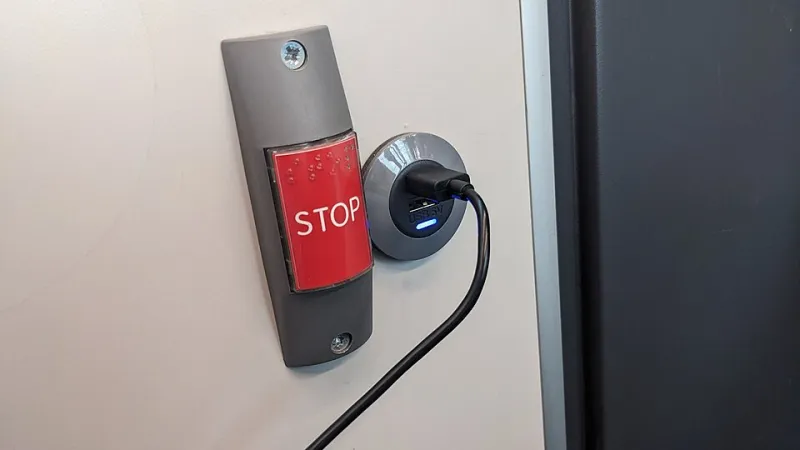
Photo: Donald Trung Quoc Don (Chữ Hán: 徵國單) - Wikimedia Commons - © CC BY-SA 4.0 International.(Want to use this image?)Original publication 📤: --Donald Trung 『徵國單』 (No Fake News 💬) (WikiProject Numismatics 💴) (Articles 📚) 05:45, 2 August 2023 (UTC), CC B
The scene is familiar to anyone who has flown through Atlanta, Denver, or Chicago O'Hare: a phone at four percent battery, a departure board counting down, and a row of open USB ports built into a charging kiosk. Most travelers plug in without a second thought. Security researchers wish they wouldn't — not because every port is malicious, but because the average person has no way to tell the difference.
The Problem Hiding Inside the Connector
The universal serial bus was designed in the 1990s to do two jobs at once: move power and move data. That dual purpose is precisely what makes it a security question. When you connect a phone to a charging station, you are not just completing an electrical circuit; you are establishing a handshake between your device and a piece of hardware you know nothing about.
In a worst-case scenario, that handshake can be abused. The technique popularly known as "juice jacking" refers to a family of attacks in which a compromised port or cable attempts to read data from, push data onto, or otherwise communicate with a connected device. The energy flow may be perfectly legitimate while the data lines carry something else entirely.
It is important to be precise about scale. There is no credible evidence that mass data theft is occurring at American airport kiosks on a routine basis, and the FBI and FCC have issued periodic warnings that are better understood as prudent cautions than as reports of an epidemic. The real risk is structural: USB offers a capability, and humans have proven remarkably good at abusing capabilities.
When the Cable Itself Is the Weapon
Charging stations are only half the story. A second, subtler threat comes from the cables people buy and carry. Researchers have demonstrated — and federal agencies have confirmed — that USB cables can be manufactured with hidden electronics inside the connector: tiny embedded chips capable of running attack tooling once the cable is plugged into a computer.
What makes this unsettling is the distribution channel. Tampered or counterfeit cables do not need to come from a shadowy corner of the internet. They can surface on mainstream online marketplaces, sold at prices that seem too good to pass up, indistinguishable from the genuine article to anyone without lab equipment. A traveler who buys a knockoff fast-charging cable for a few dollars may never know what, if anything, is coiled inside the housing.
The lesson is less about paranoia and more about supply chains. Hardware security depends on trusting the manufacturer, the shipper, and the seller — a chain most consumers cannot audit.
Red Flags Worth Learning
No one expects travelers to carry oscilloscopes. But a handful of habits meaningfully reduce exposure:
- Prefer wall adapters. A standard AC plug with your own USB cable provides power without any data pathway. It is the single easiest mitigation available.
- Carry your own cable, and treat it as personal equipment. A cable borrowed from a stranger at a conference or left in a rideshare is hardware with an unknown history.
- Watch for unexpected device prompts. If a phone asks whether to "trust this computer" when you only intended to charge, decline. That prompt exists precisely because a data connection is being requested.
- Be skeptical of giveaways. Branded free cables handed out at trade shows are a classic social-engineering vector. Free is a price, not a guarantee.
- Notice physical tampering. A connector housing that looks glued, mismatched, or unusually bulky on a public kiosk deserves suspicion.
The Ten-Dollar Answer
For those who want a technical backstop, the market offers a small device sometimes called a USB data blocker or "charge-only" adapter. It sits between the public port and your cable and physically severs the data pins, allowing only power to pass through. Because there is no data connection to exploit, the attack surface collapses to zero.
A quality data blocker costs about the same as an airport sandwich. It is not magic — counterfeit blockers exist, which is why buying from a reputable manufacturer matters — but as a component of a sensible routine it is hard to argue with. Power bank, own cable, own wall adapter, data blocker for the times when only a public port will do. Together, these cover nearly every charging scenario a traveler encounters.
A Habit, Not a Panic
Cybersecurity advice often fails because it demands either constant vigilance or expensive tooling. USB hygiene requires neither. The threat is real in the way that leaving a laptop bag visible in a parked car is real: most days nothing happens, and the cost of prevention is trivial compared to the cost of compromise.
For a nation of commuters, road warriors, and festival-goers, the takeaway is refreshingly simple. The port is not your friend or your enemy; it is an unverified stranger with the potential to be either. Treat it accordingly, spend the ten dollars, and let the battery anxiety — not the security anxiety — be the only thing you feel at the charging kiosk.